
By the numbers
Every figure here is counted from the shipping product and its test suite. Nothing is estimated, and nothing is rounded up.
About that 96 million. It is measured, not marketing. The test suite renders 200 seeds per model and measures 199 distinct Re-Dreams out of 200 draws from a single take. Neither number runs out at 200 samples, so both are floors: ≥200 generations × ≥199 Re-Dreams ≈ 40,000 takes per model per part, and 40,000 × 2,413 models is over 96 million — per part, before the four melodic parts combine. We report a floor and never a total, deliberately: a total would be a ceiling the code cannot prove, and it would turn inspiration that does not run out into a catalogue you can imagine finishing.
Search a name, not a genre
2,413 artists, producers and genres in one box — through aliases and past typos. Before you press a thing it tells you what that selection does: its era, its tempo range, the key it leans toward, its moods by name, and which parts it writes and which it does not. An artist who does not write countermelodies says so, instead of answering that tab with silence.
Re-Dream — the same idea, differently
A reroll gives you a different idea. A Re-Dream gives you the same one,
differently. Every generation arrives as four — the take you have, plus three dreamed
after it — and you hear each one in your track, against your drums and your
808. A Re-Dream shares 79% of its original's onsets where three fresh
seeds share 35%. That is a gate in the test suite, not a claim. It works on a file
too: pick a .mid in the browser and the rack fills from that instead of
from a generation.
Any audio file becomes MIDI
Drag any sample — WAV, AIFF, FLAC, MP3, M4A, OGG — onto a generator and it comes back as notes. Onsets, tempo, the loop's own length, pitch and drum content, all measured. And every part tells you why it was routed where it was, so a wrong guess is one click to redirect rather than something you find out later.
Five generators and a whole song
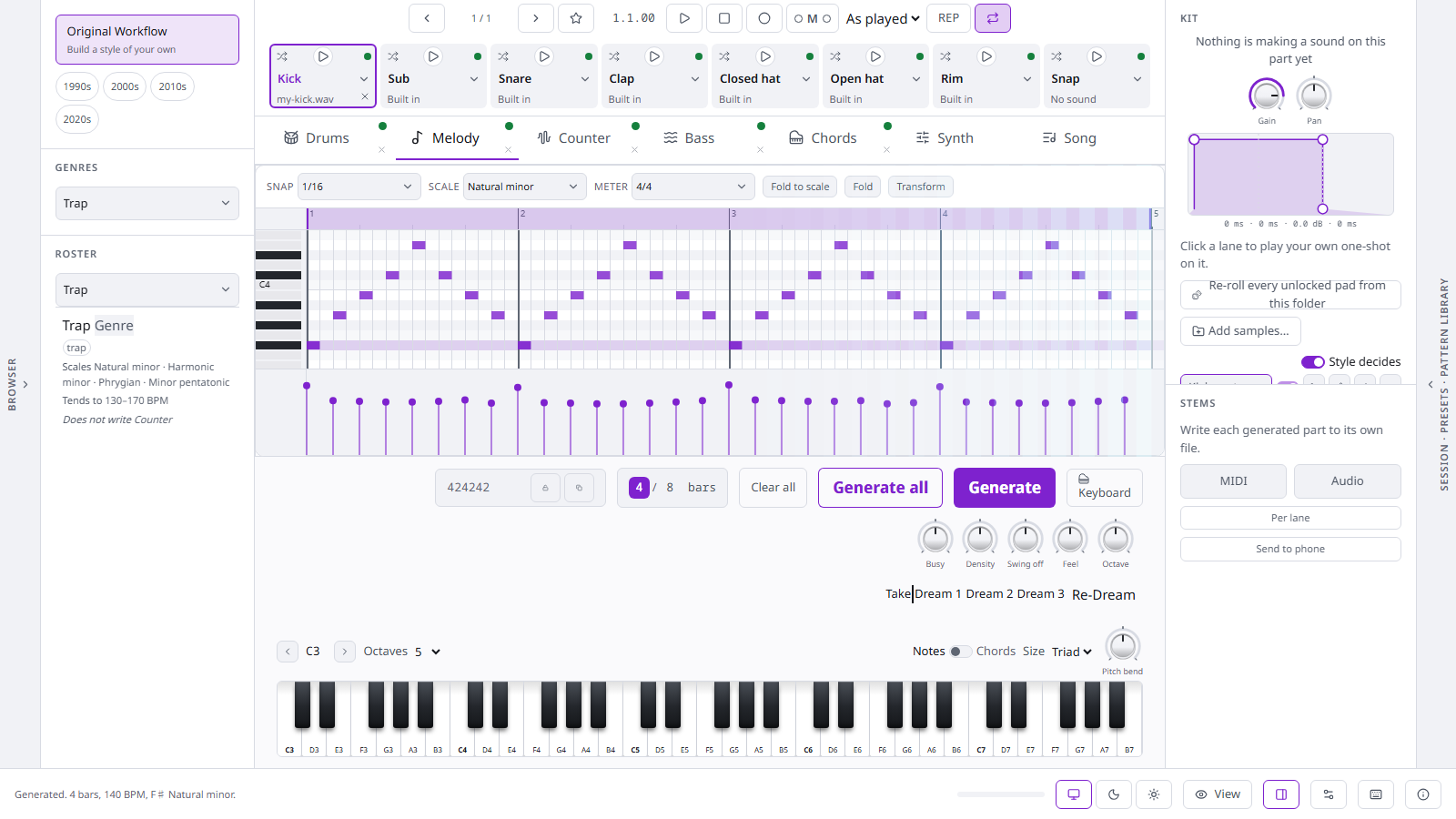
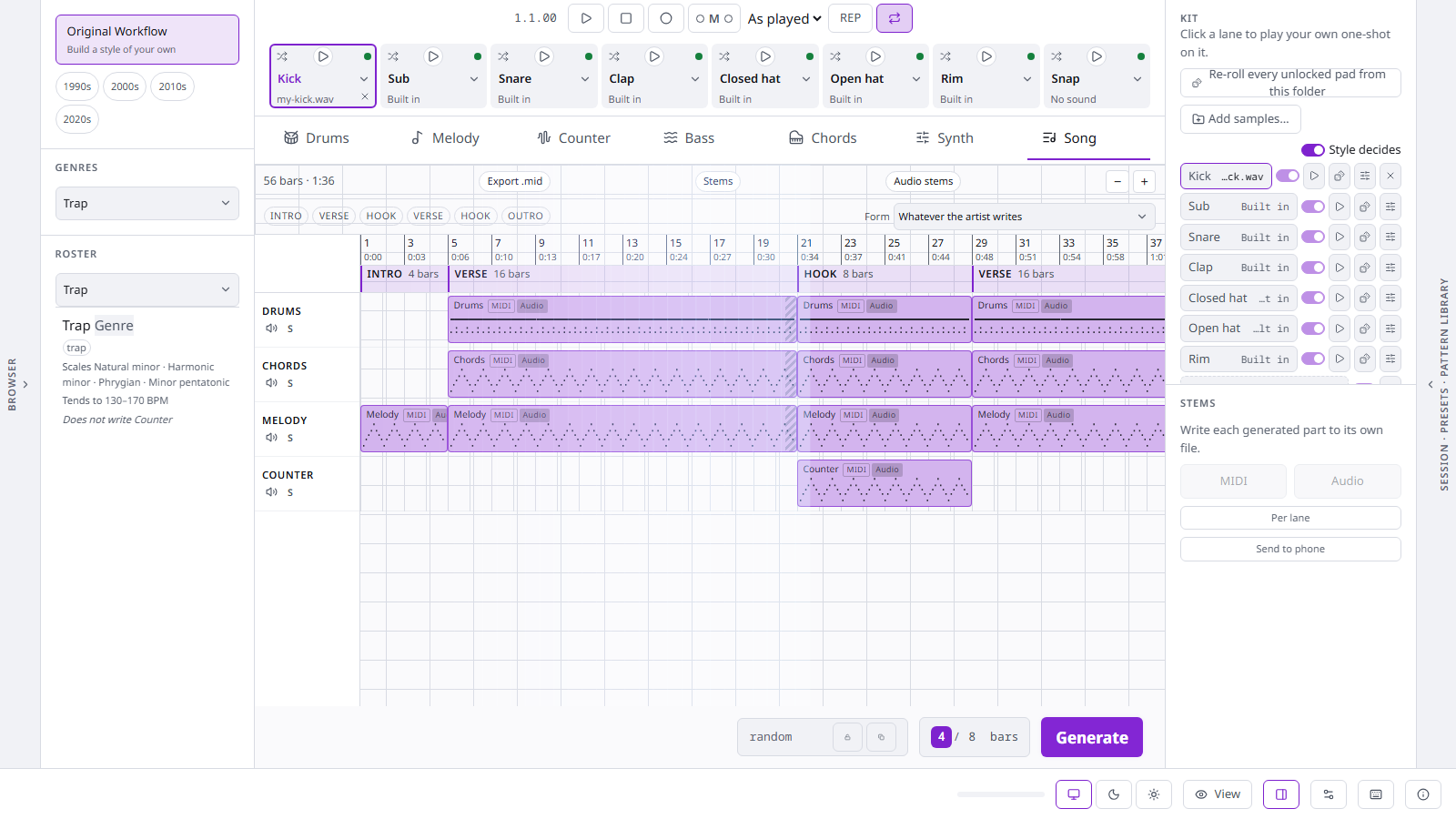
Drums · Melody · Countermelody · Bassline · Chords — plus Song Mode, which samples one of the artist's own forms and draws it on a timeline you can edit. Resize, clone, lock what you like, reroll a section without touching the rest.
It is an instrument too
A polyphonic synthesiser with 1,648 instruments across 69 genres, and each melodic generator plays its own — four voices at once, not one shared between them. Nothing is a sample library: every sound is a five-integer address, so the whole thing is a few numbers in your project file.
And you can play it in
An on-screen keyboard, your computer keys as a second one, and your own MIDI controller with a channel filter, transpose, octave, bend range and a velocity curve. Press record and what you play lands in the part's clip — a note held across the end of the loop stays one note, and recording again overdubs rather than replacing. The pitch wheel bends every instrument, the physically modelled ones included: a bell's partials and a guitar's string move with it, while the parts that do not follow a note — a violin's body, a voice's formants — stay where they belong.
5,085 MIDI loops, written by the same engine
Factory Packs: melodies, basslines, chords, countermelodies, drum loops and percussion loops, by genre. Walk them with ↑/↓ and each one plays as you land on it. Drag one onto a generator and it lands there, split onto the right parts; drag it out and it goes to your DAW as a clip. Nine megabytes of notes — not a gigabyte of somebody else's recordings, because our own generators and our own models wrote every one of them.
It will not hand you somebody else's hook
Every melody is screened against a table of well-known contours before you hear it, and a take that matches is thrown away and drawn again. The table holds one-way fingerprints and no note data at all — transposing a hook does not hide it, and nothing anybody else wrote is in the product.
Lock it, reroll it, get it back
Lock what you like and reroll the rest — a locked lane comes back note for note however many times you press Generate. Every generation has a seed: copy it, paste it, get it back. And unlimited undo across everything, because an undo entry is the inputs rather than the notes.
No AI. Not one model.
Not a limitation — the design. Rules, measurements and seeded randomness all the way down, with a build gate that refuses any dependency that would smuggle a model in. It buys you reproducibility, explainability, and provenance you can defend: nothing was trained on anybody's recordings, because nothing was trained at all.
Side by side with the leading MIDI generators
Compiled from each product's own published feature set. ● full · ◐ partial · — not offered.
| Freally MIDI Master | Unison MIDI Wizard | Scaler 3 | Captain Plugins | Orb Producer 3 | RapidComposer | Lemonaide | EZdrummer 3 | |
|---|---|---|---|---|---|---|---|---|
| Price | Free today | Paid | Paid | Paid | Paid | Paid | Subscription | Paid |
| Named artist / producer styles | ● 2,340 | — genres only | — | — | — | — | ◐ licensed roster | — |
| Drums and melody, bass, chords, countermelody | ● all five | ◐ | ◐ | ◐ | ◐ | ● | ◐ | — drums only |
| Full song arrangement on an editable timeline | ● | — | ◐ | ◐ | ◐ | ● | — | ◐ |
| Audio file → MIDI, any sample | ● | — | ◐ detection | — | — | — | — | — |
| MIDI file → split into five parts, each explaining why | ● | — | — | — | — | ◐ | — | — |
| Re-Dream — the same idea, differently | ● | — | — | — | — | ◐ morph | — | — |
| Reproducible seeds — paste it, get it back | ● | — | — | — | — | — | — | — |
| Built-in synth you can also just play | ● 1,648 | — | ◐ | ◐ | — | ◐ | — | ◐ |
| Your own samples on any lane | ● | — | — | — | — | — | — | ◐ |
| Hook screening — refuses somebody else's melody | ● | — | — | — | — | — | — | — |
| Lock what you like, reroll the rest | ● | ◐ | — | ◐ | ◐ | ◐ | — | — |
| Train a style on takes you starred | ● no ML | — | — | — | — | ◐ | — | — |
| Works fully offline, no account, no telemetry | ● | ◐ | ◐ | ◐ | ◐ | ● | — cloud | ◐ |
| No AI/ML anywhere — auditable rules | ● gated on every push | ● | ● | ● | — | ● | — | ● |
| Live collaboration rooms | ● | — | — | — | — | — | — | — |
| 18 languages | ● | — | ◐ | — | ◐ | ◐ | — | ◐ |
| Unlimited undo across everything | ● | — | — | — | — | ◐ | — | ◐ |
The one-line version: every other product on that table is asking you for money to do part of what this does. This one asks for nothing and does all of it.
Comparison compiled from each product's publicly documented feature set; products change, and corrections are welcome.
Why it is built the way it is
Reproducible
The same seed gives the same notes, today and in five years. Nothing trained can promise that.
Explainable
Every generation can tell you which parameter produced it, because there is a parameter rather than a weight.
Provenance you can defend
Nothing was trained on anybody's recordings, because nothing was trained at all. The research corpus only ever contributed distributions — never note data, never audio.
It stays on your machine
No account, no login, no telemetry, no cloud round-trip. It works on a plane. Your samples, your MIDI, your playing and your projects never leave your disk — not one sample byte crosses the wire, even in a collaboration room.
It follows your DAW
The plugin reads the host's tempo and time signature every block, so a pattern is generated for your song — trap authored at 140 comes out at 92 in a 92 BPM project. Pin a tempo yourself and yours wins.
What is still coming
Stated plainly, because a feature list that hides its gaps is not worth reading.
- macOS and Linux drag-out are written and switched on but have not been dropped into a real DAW yet. Windows has. Export works everywhere regardless.
- Global hotkeys, screen share and camera in collaboration rooms.
v1.0.0RC is coming soon, and downloads with it. Until then the honest answer to "where do I get it" is not yet.